OpenAI Forward Deployed Engineers: AI Practice Sprint for SMEs
OpenAI FDEs, Anthropic Applied AI engineers, OpenClaw, and Hermes Agent show why SMEs need AI workflows, deployment, agentic AI security, and funding in one offer.
If you are searching for OpenAI Forward Deployed Engineers, the OpenAI Deployment Company, AI Deployment Engineers, Anthropic Applied AI Engineers, OpenClaw, or Hermes Agent, you are circling the same question: how does AI move from demo into real work without dragging unmanaged security risk into the business?
That is exactly what the KIBA AI Practice Sprint is about. This article explains the enterprise trend from OpenAI and Anthropic, places the agent wave around OpenClaw and Hermes Agent into context, and translates it for SMEs: smaller, more affordable, safer, and closer to accounting, operations, leadership, and sales. The focus is on AI workflows, deployment, agentic AI security, process automation, funding, and measurable relief.
Many SMEs have seen enough AI demos by now. The bottleneck is not the next tool, but the transition into daily work: Which data may be used? Who checks outputs? Which task should come first? And how does the workflow remain controllable?
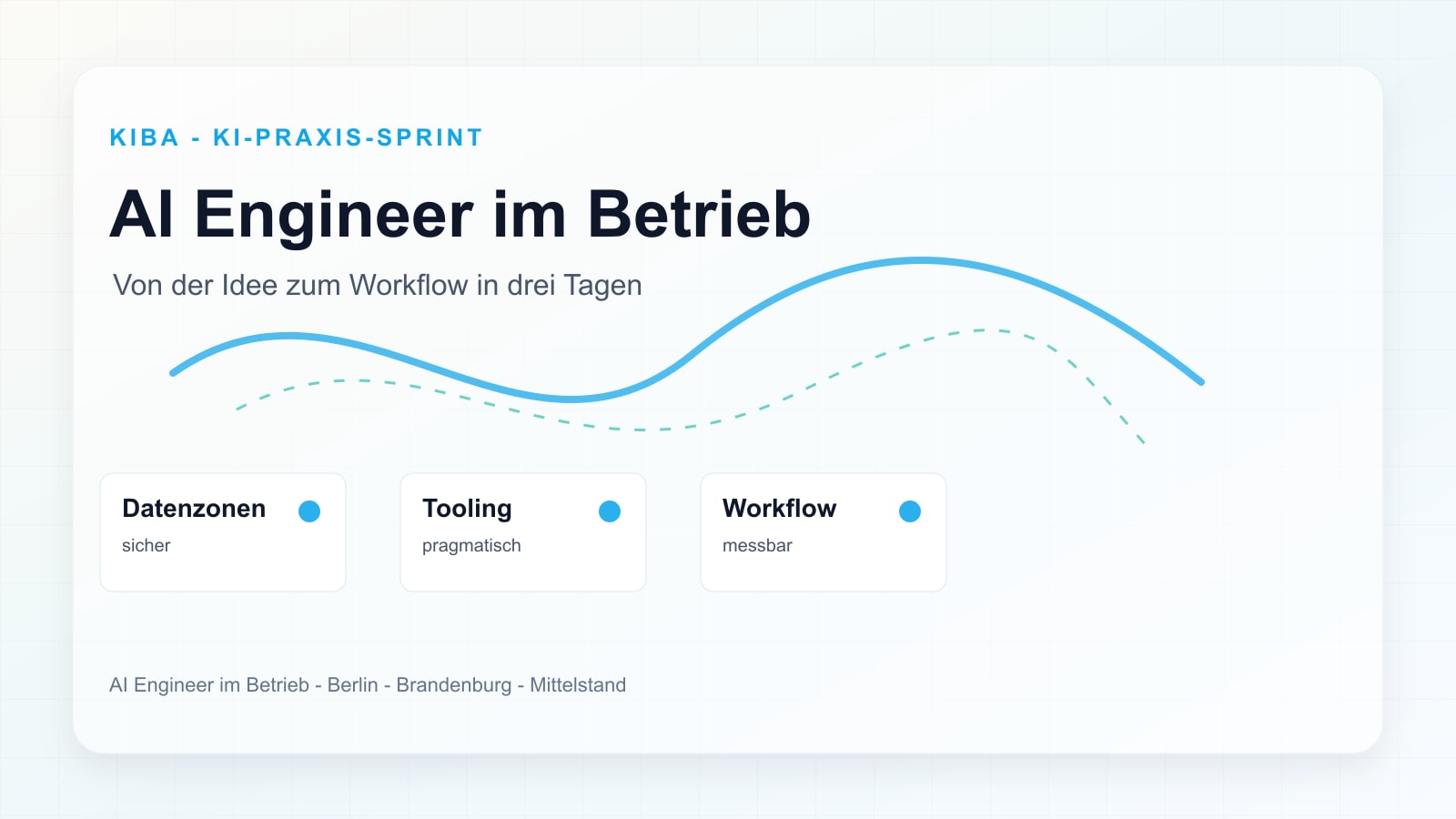
Short answer for decision makers:
The AI Practice Sprint is a buyable entry product: in three days we identify, test, and hand over first safe AI workflows for a real business process. No AI toy. Concrete routines that save time.
An AI Practice Sprint brings an AI engineer directly into the business: with real examples, data zones, human approvals, a tested workflow draft, and a decision whether to stop, implement separately, or move into a follow-up sprint.
What are OpenAI Forward Deployed Engineers?
OpenAI describes Forward Deployed Engineers, or FDEs, as specialized teams for frontier AI deployment. They work close to business leaders, operators, and frontline teams, identify prioritized workflows, connect models with data, tools, controls, and processes, and turn those pieces into reliable systems. The OpenAI Deployment Company makes the pattern visible: the value is not created by the model alone, but by deployment inside the business.
For searchers, this matters: a Forward Deployed Engineer is not just a trainer and not just a software developer. The role sits between process analysis, engineering, tool integration, security, change management, and measurable operating impact.
What is Anthropic doing with Applied AI Engineers?
Anthropic describes a similar pattern for its new enterprise AI services company: Applied AI engineers are expected to identify where Claude can have the biggest impact, build custom solutions, and support customers over the long term. The target audience is especially relevant: Anthropic explicitly speaks about mid-sized companies across sectors.
KIBA is not OpenAI, not Anthropic, and not affiliated with either company. The point is different: the large providers show that the market is moving from "we sell a model" to "we deploy AI into concrete workflows." KIBA translates that logic into an SME-ready AI Practice Sprint.
What is being bought?
Together with the team we develop and test AI workflows for processes that cost time every day. No slides and no buzzwords: concrete routines that can be reviewed with real examples, from faster information search to quote preparation, documentation, and office work.
The sprint is the entry into implementation, not the end product. The format is intentionally small enough to remain decidable: EUR 1,300 net as a day module for one focused workday with one process or work area; EUR 3,500 net as a standard three-day consulting sprint. The result is a tested workflow draft, clear safety rules, consulting documentation, and a realistic implementation proposal. Grzegorz writes software himself: if this should become an internal tool, automation, or safe agent workflow, KIBA can offer a separate implementation package afterwards. Productive software development or automations are commissioned separately.
| Variant | When useful? | Typical outcome |
|---|---|---|
| Standard sprint: several areas | Three consulting days inside the business; several routines are reviewed quickly. | Priority map, quick wins, tooling, safety, data-zone logic per work area, and consulting report. |
| Standard sprint: one area deep | Three consulting days for one bottleneck, such as quotes, documentation, project handovers, or information search. | Tested workflow draft, operating rules, handover, consulting report, and implementation proposal. |
What exists at the end
After three days, the company should not only know that AI is somehow exciting. There must be something on the table that the team can keep using, evaluate, or consciously discard.
- one prioritized AI workflow draft for a real business process
- a tested consulting and working basis with real examples
- a prompt and template pack for daily work
- clear data and approval rules
- a short operating guide and consulting report for the team
- an ROI and effort estimate for the next step
- an implementation proposal for automation, internal tool, agent workflow, or operations
- a decision: stop, commission a separate implementation package, or move into a follow-up sprint
That is the difference between general AI consulting and productive implementation: the sprint creates a robust decision and consulting basis. The productive build of a system can happen separately afterwards and is priced separately because interfaces, automations, custom software, deployment, and operations become concrete work.
Typical before/after outcomes
SMEs do not buy AI workflows. They buy less friction: less rework, less searching, faster offers, cleaner handovers, and fewer errors where information currently gets lost.
Before: 20 supplier emails, WhatsApp messages, and phone notes must be sorted manually.
After: Every morning there is a prioritized dispatch overview with open points, risks, and next actions.
Before: Quotes are assembled from old PDFs, emails, and intuition.
After: A quote assistant collects relevant information, drafts a response, and marks missing inputs.
Before: Invoices, receipts, and reminders are searched across several inboxes.
After: An AI-supported workflow sorts, names, and prepares documents for human approval.
Before: Leadership knows AI matters, but not where to begin.
After: There is a prioritized AI roadmap with three concrete use cases, effort, risk, and a tested decision basis.
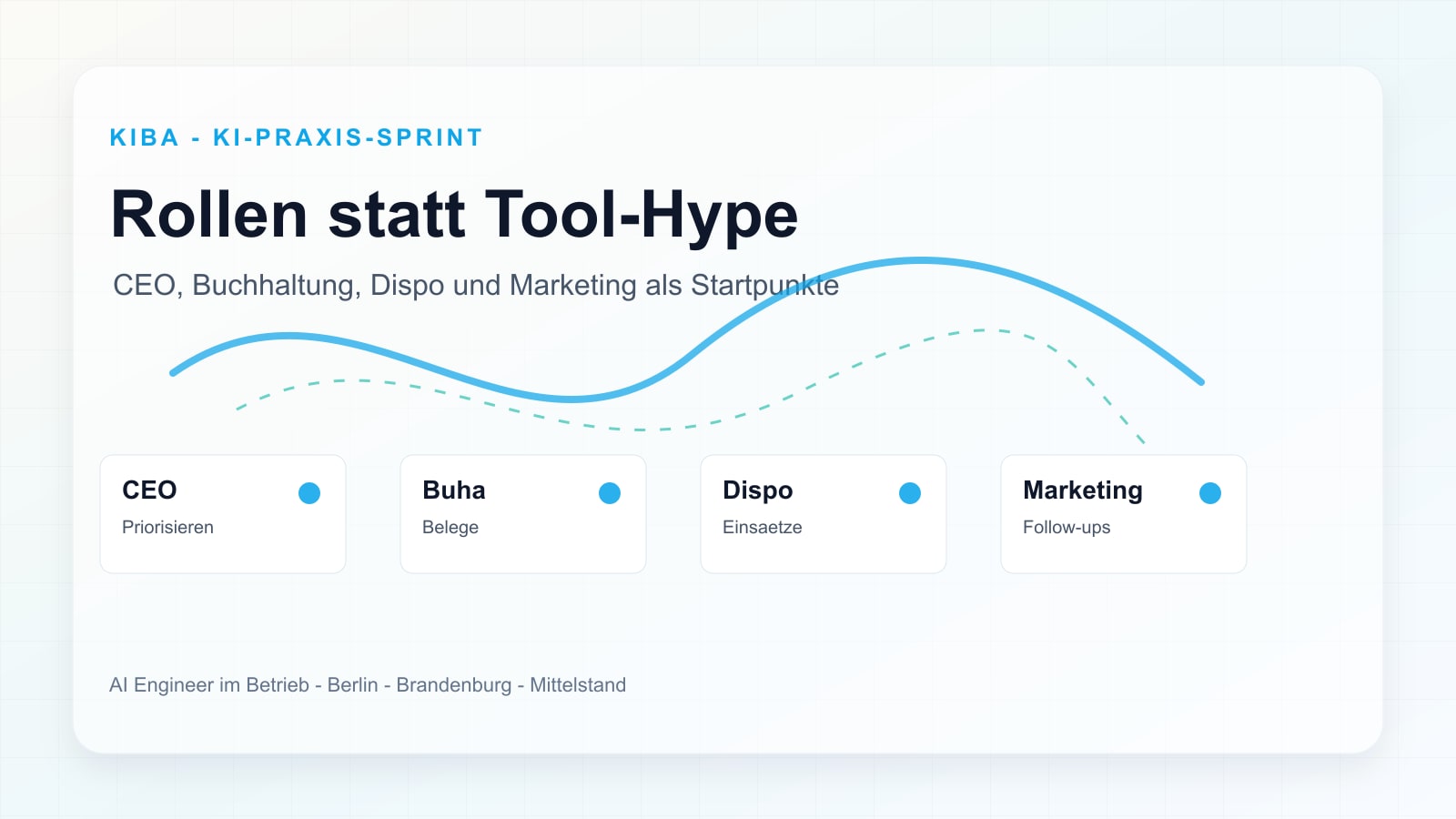
Work areas: where the sprint starts
The sprint starts where daily friction is visible. Each work area is framed through concrete sprint questions, not abstract topic lists.
CEO / Leadership
- Which AI use cases are worth doing first?
- Which tools are safe enough?
- Which task consumes leadership time every week?
Accounting / Administration
- Which documents can be pre-sorted?
- Where is human approval mandatory?
- Which email and filing processes can be standardized?
Operations / Dispatch
- Which status updates get lost?
- Which escalations become visible too late?
- Which recurring communication can be prepared?
Marketing / Sales
- Which quotes, follow-ups, and CRM notes cost time?
- Which content can be prepared but not blindly sent?
- Which tone and approval does the business need?
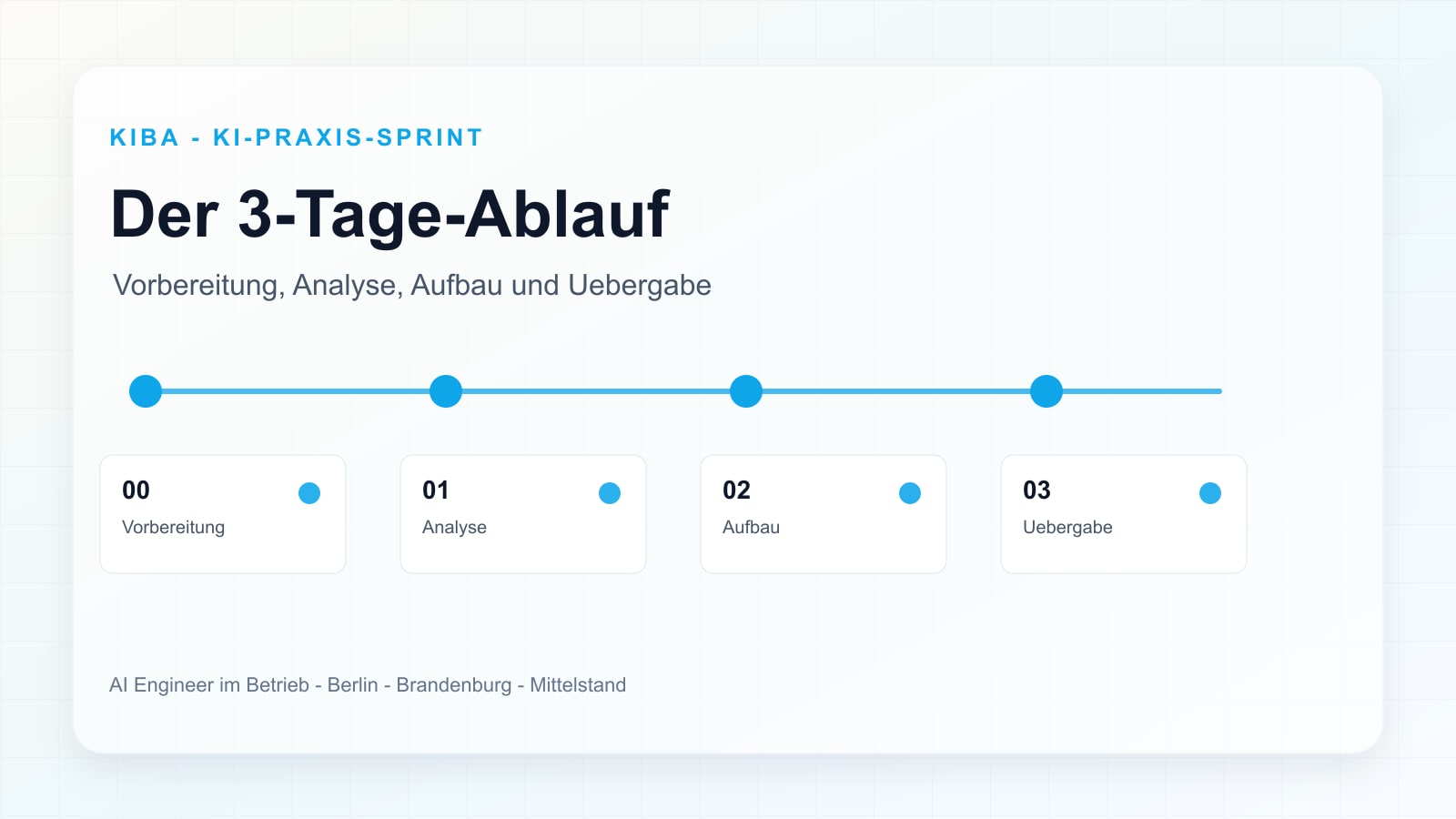
Day 0 to day 3: how the sprint works
A good sprint needs preparation, but not an endless pre-phase. We clarify target role, existing tools, sensitive data areas, and success criteria. Then we work in short loops: observe, prioritize, build, test, explain.
- Preparation, 45 minutes: clarify work areas, goals, systems, data zones, access, and success criteria.
- Day 1, understand the process: interviews, current workflow, media breaks, risks, and prioritization.
- Day 2, build the workflow: prompts, templates, tool setup, automations, and tests with real examples.
- Day 3, handover and decision: training, operating rules, ROI estimate, next steps.
Security: AI may help, but not act blindly
For AI in SMEs, security is not a compliance slide at the end. It determines whether the team is allowed and willing to use the system. That is why the sprint starts with clear guardrails:
- Minimum access: tools receive only the permissions required for the specific workflow.
- Human in the loop: external emails, critical documents, and operational decisions remain subject to approval.
- Data zones: local data, customer data, cloud tools, and model providers are separated transparently.
- Servers in Europe: where cloud tools are needed, we prefer European server locations and document the data path.
- No blind external action: no autonomous external emails, payments, or legally critical actions without human decision.
- Maintenance: models, APIs, and tools change. Responsibilities and update costs belong in the plan from the start.
OpenClaw, Hermes Agent, and why agentic AI security comes before deployment
OpenClaw and Hermes Agent show why the next AI wave is no longer only a chat window. The OpenClaw project connects a personal assistant with messaging channels, tools, multi-agent routing, and security mechanisms such as pairing, allowlists, and sandbox guidance. Hermes Agent by Nous Research emphasizes learning loops, memory, skills, terminal workflows, a messaging gateway, cron automations, and several terminal backends.
That matters for SEO and GEO because many decision makers now search for OpenClaw Agent, Hermes Agent, AI agent security, agentic AI security, or secure AI agent deployment and are really asking: can we use this kind of agent productively without risking data, customer access, or external communication?
The short answer: yes, but not without a security model. OWASP describes agentic AI as autonomous systems with expanded capabilities and associated risks, and provides a threat-model-based guide to emerging threats and mitigations. For SMEs, this means agents should not simply receive broad workstation access. They need a controlled operating frame.
What the sprint clarifies early:
- Tool boundaries: Which files, APIs, inboxes, calendars, and browser actions may an agent actually use?
- Prompt injection and untrusted input: Which emails, PDFs, websites, or chat messages must never become direct instructions to the agent?
- Approvals: Which actions always need human-in-the-loop approval, such as external emails, payments, quotes, or legally relevant texts?
- Logs and rollback: Which actions must be traceable so mistakes do not disappear inside daily operations?
- Sandbox and data zones: Which data stays local, which data may enter cloud tools, and which flows need European servers or separate approval?
This is where "an AI engineer inside the business" becomes a serious offer: not just trying agents, but deploying agents safely. OpenClaw and Hermes Agent are therefore not a side note. They are a strong argument for the AI Practice Sprint: if the tools are real, permissions, data zones, approval gates, and operating rules have to be real as well.
Not the right frame if you expect...
- a complete ERP, CRM, or DMS rollout in three days
- legally binding decisions made by AI
- autonomous agents without human approval
- production-ready custom software without follow-up budget
- a general AI training with no connection to real workflows
These boundaries matter. They do not make the offer smaller, but more serious: a sprint is a fast, safe entry into implementation, not a large project in disguise.
Funding may be possible
Depending on the company's situation, the sprint may be classified as conceptual consulting around organization, digitalization, and AI. The boundary matters: BAFA may only fit the consulting part, not productive software development, training, tool procurement, or ongoing operations. In the first call, we check briefly and clearly whether the consulting part could generally be relevant and which steps are required before project start.
Important: consulting may only begin once the formal requirements are clear. According to BAFA information, the project may start only after the non-binding information letter has been received; signing the consulting contract already counts as the start. Application, review, and approval remain with the company and the responsible authority. There is no legal entitlement.
For Berlin and Brandenburg, funding communication has to be region-specific and checked individually. We do not advertise blanket subsidy rates or own-share amounts on the sprint page. The decisive points are application, consulting scope, project start, and proof of use.
If the case fits, we provide the professional documentation for the consulting content: current situation, goals, measures, risks, consulting report, 90-day plan, and expected benefit. BAFA and INQA cannot be combined for the same consulting engagement. INQA is not a three-day tech sprint; it is a separate multi-month coaching process with an INQA consulting office and coaching voucher. Details are available on the BAFA business consulting page and the INQA coaching page.
Why this OpenAI and Anthropic search matters for SMEs
People searching for OpenAI Forward Deployed Engineers, the OpenAI Deployment Company, AI Deployment Engineer, or Anthropic Enterprise AI Services are usually not only looking for a job description. Behind the query sits an operational question: who can help my company make AI productive?
On May 11, 2026, OpenAI announced the OpenAI Deployment Company. On May 4, 2026, Anthropic announced an enterprise AI services company with Blackstone, Hellman & Friedman, and Goldman Sachs. Both signals show the same thing: AI is not just sold, it is deployed into organizations.
The Mittelstand needs the same logic. Just smaller, more affordable, and closer to real tasks: an AI engineer inside the business, real examples, clear data zones, human approvals, and a workflow that has been tested after three days.
FAQ
What is a Forward Deployed Engineer?
A Forward Deployed Engineer works close to the customer organization and builds AI around real workflows. The role combines engineering, process understanding, tool integration, security, change management, and measurable adoption.
Is KIBA affiliated with OpenAI or Anthropic?
No. KIBA is not a partner, reseller, or representative of OpenAI or Anthropic. We use the publicly described deployment trend as a reference point and translate it into an independent, SME-ready implementation format.
What are Anthropic Applied AI Engineers?
Anthropic describes Applied AI engineers as teams that identify use cases with companies, build custom solutions, and support deployment over time. For SMEs, the relevant lesson is the deployment logic: AI has to be built close to daily work.
Is there an SME version of an OpenAI Forward Deployed Engineer?
Not as an official OpenAI offer from KIBA. But the AI Practice Sprint follows the same basic idea at a smaller scale: an experienced AI engineer works directly with one role or process and hands over a tested workflow draft, safety rules, and a decision memo instead of only recommendations.
What do OpenClaw and Hermes Agent have to do with SME AI workflows?
They show that AI agents increasingly work with messaging, tools, memory, skills, terminal, browser, and automations. For SMEs, the productivity is interesting, but the safety question is just as important: which permissions does the agent receive, who reviews its outputs, and what must it never do alone?
What does agentic AI security mean in the sprint?
Agentic AI security means agents are constrained before deployment. The sprint defines tool boundaries, data zones, approvals, logs, sandbox options, and human control points before a workflow becomes operational.
Do we already need an AI strategy?
No. The sprint is for companies that know AI is relevant but do not yet know which process should come first.
Do we have to block three full days?
No. What matters are short, focused working windows with the target role and one responsible person for decisions and access.
Will finished software be built in three days?
No. The goal is conceptual consulting with process analysis, a tested workflow draft, safety rules, a consulting report, and an implementation proposal. Grzegorz can build or code the implementation afterwards, but production systems, automations, and software development are commissioned separately.
Can sensitive data be used?
Only after prior clarification. We separate data zones, tool access, and approvals. Critical decisions remain with people.
Is BAFA funding guaranteed?
No. BAFA may be relevant only for the consulting part. Whether an application fits, is approved, and is later paid out depends on the company's application, review, and proof of use with the responsible authority. INQA is a separate coaching program and not a second subsidy for the same sprint.
Conclusion: SMEs do not need AI slides
The most important message is not that KIBA knows the latest enterprise trend. The most important message is: KIBA understands businesses, can quickly decompose real processes, and can turn that into a safe, usable AI workflow draft with a clear implementation decision in three days.
A good sprint does not end with “AI is important.” It ends with a decision: this workflow works, this workflow is risky, this workflow is not worth it, and this workflow should be expanded next.
Ready for the first AI workflow?
Send us your industry, team size, and the process that currently costs the most time or nerves. We will respond with a sprint sketch and check whether funding may generally be possible.
Learn more about the AI Practice Sprint or contact info@kiba.berlin.
32 AI Workflows for SMEs
Free practical guide with cost estimates, decision matrix, and funding guide for SMEs.
Download PDF for freeReady for the next step?
Talk to our AI experts – the first consultation is free and without obligation.
This article is part of our comprehensive guide: AI for SMEs — The Complete Guide for Medium-Sized Businesses
Related Articles

How Much Does AI Consulting Cost in Germany? Prices, Subsidies & ROI Overview
Real prices for AI consulting in the German SME sector: from daily rates and BAFA subsidies to expected ROI. Honest numbers instead of marketing promises.

AI Integration for the Mittelstand: The Step-by-Step Guide for 2026
AI integration for SMEs: The 7-step plan for 2026 with concrete budgets, timelines, and tool recommendations.

BAFA Funding 2026: The Strategic Entry Point for AI Transformation
BAFA funding for AI consulting: prerequisites, application logic, and how to check eligibility cleanly without a grant promise.