The New Currencies: Why Enthusiasm Is the Last Scarce Resource
From time to attention to enthusiasm: Why AI agents are shifting the scarce resource -- an economic analysis.

At a Glance
- The scarcest resource in knowledge work has shifted three times: from time (finite, 24h/day) to attention (focusable, but limited) to enthusiasm (the new bottleneck).
- A narrative of a 100-1000x productivity factor through agentic AI circulates in the tech scene -- a deliberate exaggeration, not a measurement, but it describes the direction: those who orchestrate AI agents achieve in hours what used to take months.
- "All your thoughts in a year are worth $10": A deliberately provocative formula from the tech scene -- cognitive work is becoming a commodity, and the price for pure knowledge is falling rapidly.
- No economic model has priced in superintelligence. The previous assumption: human intelligence ranges from average to Einstein. That assumption is obsolete.
- An anecdote from The Atlantic: a software developer is said to have used Claude Code to work on an mRNA cancer therapy for his dog -- an example that should be on every billboard, but doesn't fit the doom narrative.
It was a Tuesday morning, around half past seven. Coffee, laptop open, the usual ritual. I opened my to-do list -- and it was empty. Not because I'd forgotten to fill it in. But because my AI agent had worked through the open items overnight. Research done, drafts written, code problems solved, even a summary of results left behind. Neatly organized, with sources cited.
I stared at the screen. In my head, a scenario played out that I know from Star Trek: Captain Picard sits on the bridge, gives an order, and the ship -- that impossibly intelligent machine -- executes it. Picard doesn't have to navigate himself, doesn't have to calculate himself, doesn't have to repair anything himself. He just has to know where he wants to go.
And that's precisely the problem. Because the question that confronted me on that Tuesday morning wasn't: What do I have to do today? It was: What can I get excited about today?
Sounds absurd. It is. And at the same time, it may be the most important economic shift of our generation.
The Currency of Time -- Finite and Merciless
Let's start at the beginning. For millennia, the scarcest resource of the working human being was time. 24 hours a day, 365 days a year, non-negotiable. Whether you were a pharaoh or a field worker -- the clock ticked the same for everyone. The entire history of work organization is, at its core, a history of time optimization: How do we extract the maximum from the limited hours of a human life?
Frederick Taylor's Scientific Management, Henry Ford's assembly line, the Japanese Kaizen philosophy -- all attempts to use the currency of time more efficiently. Every second counts. Every hand movement is optimized. The human as clockwork, synchronized with the machine.
The logic behind it was brutally simple: Whoever invests more hours produces more. Whoever invests more cleverly produces even more. But the upper limit always remained the same -- 24 hours, minus sleep, minus eating, minus what we call "life." The Protestant work ethic practically sanctified this scarcity: Work as worship, idle hands as the devil's tools. Whoever isn't toiling is morally suspect.
This ethic worked -- remarkably well, in fact. It led the West to unprecedented prosperity. One can reasonably argue that an average German employee in 2026 leads a materially better life than a medieval king. Running water, heating, antibiotics, airplanes, Netflix. The colonial history that partially enabled this prosperity is written on a different page -- and it's a debt we must not forget. But the productivity achievement in itself is remarkable.
Yet at some point, time optimization hit its physical limits. You can't make a person work more than 24 hours a day. You can't speed them up indefinitely without quality, health, and ultimately the person themselves breaking down. The currency of time was exhausted. A new one was needed.
"Attention Is All You Need" -- The Era of Attention
In 2017, eight researchers at Google published a paper with a title that, in its seeming casualness, would change the world: "Attention is all you need." Technically, the paper described the Transformer architecture -- the foundation on which every large language model stands today. From GPT to Claude to Gemini: Everything is built on this one idea. Attention is all you need.
But the title was more prophetic than its authors could have imagined. Because it didn't just describe a technical architecture -- it described the zeitgeist of an entire epoch.
Sometime in the 2010s, it became clear that time was no longer the scarcest resource -- attention was. The Attention Economy was born. Herbert Simon had articulated it as early as 1971: "A wealth of information creates a poverty of attention." But only with smartphones, social media, and the permanent sensory overload of the digital age did this poverty become a mass phenomenon.

Suddenly it was no longer about how many hours you work. It was about what you direct your attention toward. Cal Newport's "Deep Work" became a bestseller because it spoke a truth every knowledge worker felt in their gut: The ability to focus attention is the real competitive advantage. Not the number of hours. Not even knowledge. But focus.
Entire industries sprang up around the attention economy. Silicon Valley built a trillion-dollar ecosystem that, at its core, does nothing other than harvest, bundle, and sell human attention. Every scroll on Instagram, every push notification, every algorithmically optimized news feed -- all design decisions in the battle for the most precious resource of the 21st century: your attention.
For entrepreneurs, this had concrete consequences: Whoever managed to direct their people's attention to the right problems won. Whoever squandered it in meetings, email chains, and Slack channels lost. Attention management became a core competency for every leader.
And then something happened that nobody had anticipated: The Transformer architecture -- "Attention is all you need" -- made attention itself scalable. Not human attention, mind you. Machine attention. Suddenly, algorithms could "focus" on billions of data points simultaneously and extract patterns that no human brain could ever have recognized. AI became the attention machine par excellence.
And that's when the next shift began. If machines can do attention better than humans -- infinitely scalable, never tiring, never distracted -- what remains as the human bottleneck?
The Shift to Enthusiasm: When the To-Do List Is Empty
We're now in March 2026, and reality has caught up with science fiction. Agentic AI systems -- systems that don't just answer questions but independently solve tasks, plan, and execute -- have arrived in the mainstream. Not perfect, not flawless, but functional enough to take over entire task chains.
What we see in consulting practice: Companies deploying agentic systems report productivity gains that can no longer be explained by classical optimization logic. Not 20%, not 50%. We're talking about a factor of 5 to 10 -- in some areas, a factor of 100. A single developer with a well-configured AI agent delivers output that would have kept a team of ten busy just two years ago.
The productivity cascade of agentic AI (a pointed narrative, not measured values):
- 2023: AI as assistant -- answers questions, writes drafts (factor 2-3x)
- 2024: AI as co-pilot -- works alongside you, corrects, iterates (factor 5-10x)
- 2025: AI as agent -- plans, executes, delivers results (factor 10-50x)
- 2026: AI orchestration -- one person directs dozens of agents in parallel (factor 100-1000x)
And here it gets interesting. If your time is no longer the bottleneck because the machine works 24/7. If your attention is no longer the bottleneck because the agent focuses independently. What remains as the scarce resource?
The answer is as simple as it is surprising: Enthusiasm.
Enthusiasm -- or call it passion, drive, intrinsic motivation -- is what cannot be delegated. No agent can be enthusiastic for you. No algorithm can burn for you. The machine can do everything, but it cannot want. The wanting -- the real, deep, sincere wanting -- remains the last human domain.
And this has consequences that reach far beyond individual productivity. Because enthusiasm isn't evenly distributed. It can't be produced by work instruction. It can't be measured, optimized, or Taylorized. It comes -- or it doesn't. And when it doesn't come, the most powerful AI agent in the world is useless to you, because nobody tells it where to run.

Concretely, this means: The motivational economies are shifting radically right now. If you as a client or as an employer fail to kindle enthusiasm -- in your employees, your consultants, your partners -- then you don't just lose their best work. You lose the only input that's still scarce in a world of ubiquitous machine intelligence. You lose what drives the machine.
In the old world, you could use money and pressure to make people do things that didn't excite them. That worked because human labor was the bottleneck. In the new world, human labor is no longer a bottleneck for many cognitive tasks. The bottleneck is the question: What is it worth running the machines for?
When a Thousand Intelligences Wait for One
Picture this: You're sitting at your desk, and behind you stand a thousand brilliant assistants. Each one faster, more precise, and more tireless than any human expert. They're all waiting for a single input: Your instruction. Your idea. Your spark.
That is the reality of agentic AI in 2026. A single person orchestrating these systems has leverage that has never existed in the history of humankind. Not the Emperor of China with his millions of subjects. Not the CEO of a Fortune 500 company with 100,000 employees. But one person, with a laptop, directing a thousand intelligences.
The math is as simple as it is staggering: If a single intelligence -- one agent -- completes an hour of work in one minute, and you run a hundred of them in parallel, you effectively have 6,000 labor hours per hour. That's the equivalent of three full-time employees' annual output. Per hour.
The Atlantic Example: mRNA Against Cancer -- with Claude Code
An article in The Atlantic recently told the story of a software developer whose dog had been diagnosed with cancer. With no background in molecular biology or pharmacology, according to the report, he used Claude Code -- an AI-based coding tool -- to work on an experimental mRNA cancer therapy that is said to have ultimately been administered. It is an anecdote from a magazine article, not a scientifically documented case -- but this story should be on every billboard. But it isn't, because it doesn't fit the doom narrative. A non-expert who, with AI support, produces a biotechnological innovation that would normally have occupied a research team of 20 scientists for years -- that's the quiet revolution happening right now. Not in laboratories. Not in corporations. But in living rooms.
Now multiply that. Not one software developer with an idea, but millions of people worldwide, each with access to the same tools. Each capable of setting dozens or hundreds of AI agents on a problem that moves them. The question is no longer: Who has the resources to solve this problem? But rather: Who has the enthusiasm to tackle it in the first place?
The difference between someone who orchestrates zero agents and someone who orchestrates a thousand isn't a linear increase. It's a categorical leap. It's the difference between someone walking across Europe on foot and someone sitting in a jet. The same world, but two entirely different realities of what's possible in a lifetime.
And here lies the blind spot of our economic models: They never priced in this multiplier. All classical economic theories -- from Adam Smith through Marx to Keynes -- are based on the assumption that human productivity falls within a certain range. Differences between individuals? Sure, a factor of maybe 2 to 5. Between an average worker and a genius like Einstein? Maybe a factor of 10 to 100, measured by total contribution over a lifetime.
But a factor of 1,000? In real time? Through orchestration of external intelligence? That was not accounted for in any model. And that is precisely what is happening right now.
"All Your Thoughts Are Worth $10" -- The Devaluation of Knowledge
Here it gets uncomfortable. If AI systems make thinking scalable, then thinking itself is no longer a scarce resource. And when something isn't scarce, it loses its economic value. That's not speculation -- that's foundational economics.
A provocative formula circulates in the tech scene: "All your thoughts in a year are worth $10." What it means: The sum of all cognitive outputs a single person produces in a year -- ideas, analyses, decisions, texts -- can now be reproduced at a fraction of the cost by machines. Not the same quality? Perhaps. But in 80% of cases, good enough. And the price tag keeps dropping.
To be clear: This doesn't only affect simple cognitive work. Not just summarizing texts or answering standard emails. It increasingly affects what we've previously classified as "higher-order" thinking: strategic analysis, creative problem-solving, even scientific hypothesis formation.

The devaluation cascade of cognitive work:
- Stage 1: Routine communication (emails, standard responses) -- machine-replaceable since 2023
- Stage 2: Research and analysis (market reports, due diligence) -- 80% automatable since 2024
- Stage 3: Creative production (texts, design, code) -- achievable in usable quality by machines since 2025
- Stage 4: Strategic decision-making -- increasingly AI-supported in 2026, human validation still critical
- Stage 5: Scientific innovation -- first breakthroughs through AI-guided research (see mRNA example)
The paradox is: Knowledge is becoming less valuable, while the ability to generate knowledge has never been more powerful. It's like the printing press -- after Gutenberg, each individual book became cheaper, but the total amount of available knowledge exploded. The difference from today: The explosion isn't happening over centuries, but in months.
What does this mean for you as an entrepreneur? It means that knowledge advantages are becoming ever shorter-lived. The exclusive industry expertise you built up over 20 years? A well-prompted agent can assemble a substantial portion of it in a week. Not everything -- not yet. But enough to dramatically lower the barriers to entry in your market.
Those who have defined themselves through knowledge -- as consultants, as experts, as "the one who knows" -- face an existential reassessment. Knowledge alone is no longer enough. What counts is the combination of knowledge, judgment, relationships, and -- there it is again -- the enthusiasm to actually do something specific with it all.
Because the machine has all the knowledge in the world. What it doesn't have is an opinion about what's important.
The Bricklayer and the Orchestrator: The Greatest Economic Discontinuity in 200 Years
There's an image that has haunted me for weeks. Anyone who has visited Egypt and observed construction work knows the scene: One man is laying bricks. Around him stand 20, 25 others, watching. Not out of laziness -- that would be a cynical misunderstanding. But because in an economy with low wages and little capital access, human labor is worth almost nothing. There are more hands than tools. More people than tasks. The work itself is the bottleneck, not the workers.
Now place that image next to the AI-augmented knowledge worker in Berlin, London, or San Francisco. One person who, with their laptop and a handful of AI agents, generates the output of an entire department. Not 25 people watching someone work -- but 25 machines working for one person.
The difference between these two scenes isn't gradual. It is the greatest economic discontinuity since the Industrial Revolution. Perhaps the greatest ever. Because even the steam engine only multiplied human labor physically. What we're experiencing now is the multiplication of cognitive labor -- and with a lever that is orders of magnitude more powerful.
Historical Parallels -- and Where They Break Down
The steam engine replaced muscle power at a ratio of 1:10 to 1:50. The computer replaced calculating power at a ratio of 1:1,000,000. But both followed a logic economists understood: More capital, more output, but human intelligence remains the bottleneck. Agentic AI breaks this pattern. It doesn't just replace individual cognitive functions -- it replaces the entire cognitive process from analysis through planning to execution. And it does so at marginal costs trending toward zero. No economic model of the 20th century can explain what happens when intelligence suddenly becomes available in unlimited quantities.
At this point, an honest word about privilege is warranted. The ability to think about enthusiasm as a scarce resource is itself a privilege. The Egyptian bricklayer probably doesn't have the luxury of wondering what excites him -- he needs to feed his family. The debate about "intrinsic motivation as a productivity driver" is a luxury debate of the Global North, conducted by people with fast internet, access to cloud computing, and an education system that put them in a position to orchestrate AI agents in the first place.
Downplaying this privilege would be dishonest. But dismissing it would be equally wrong. Because the tools are there. And they're getting cheaper, more accessible, more widespread -- faster than any technology before them. A smartphone and a Claude subscription cost less than a textbook at a German university. The democratization is happening -- not fast enough, not fairly enough, but it is happening.
The moral question isn't: Are we allowed to use these tools? It's: How do we make sure the Egyptian bricklayer gets them too?
The Scratching Post of Displeasure: What Happens When Work Becomes Optional?
There's an uncomfortable counterargument to all of this, and it deserves to be taken seriously: What about work that nobody finds exciting -- but that still needs to be done? And more: What about the character that is shaped precisely through such work?
Work that isn't fun has always served as a scratching post for character. The persistence when things get boring. The discipline to fight your way through a dull report. The resilience that comes from doing things you don't want to do. The Protestant work ethic isn't just economic, it's also pedagogical: Work shapes the person.
Can one make a moral argument that people should do things that don't excite them? Just because it's "good for character"? Difficult. Very difficult, in fact. Because the same argument has historically been used to justify exploitation. "Hard work is good for you" was also what the colonial masters said. "Suffering builds character" was also what the factory owner said in the 19th century, whose child laborers worked 14-hour shifts.
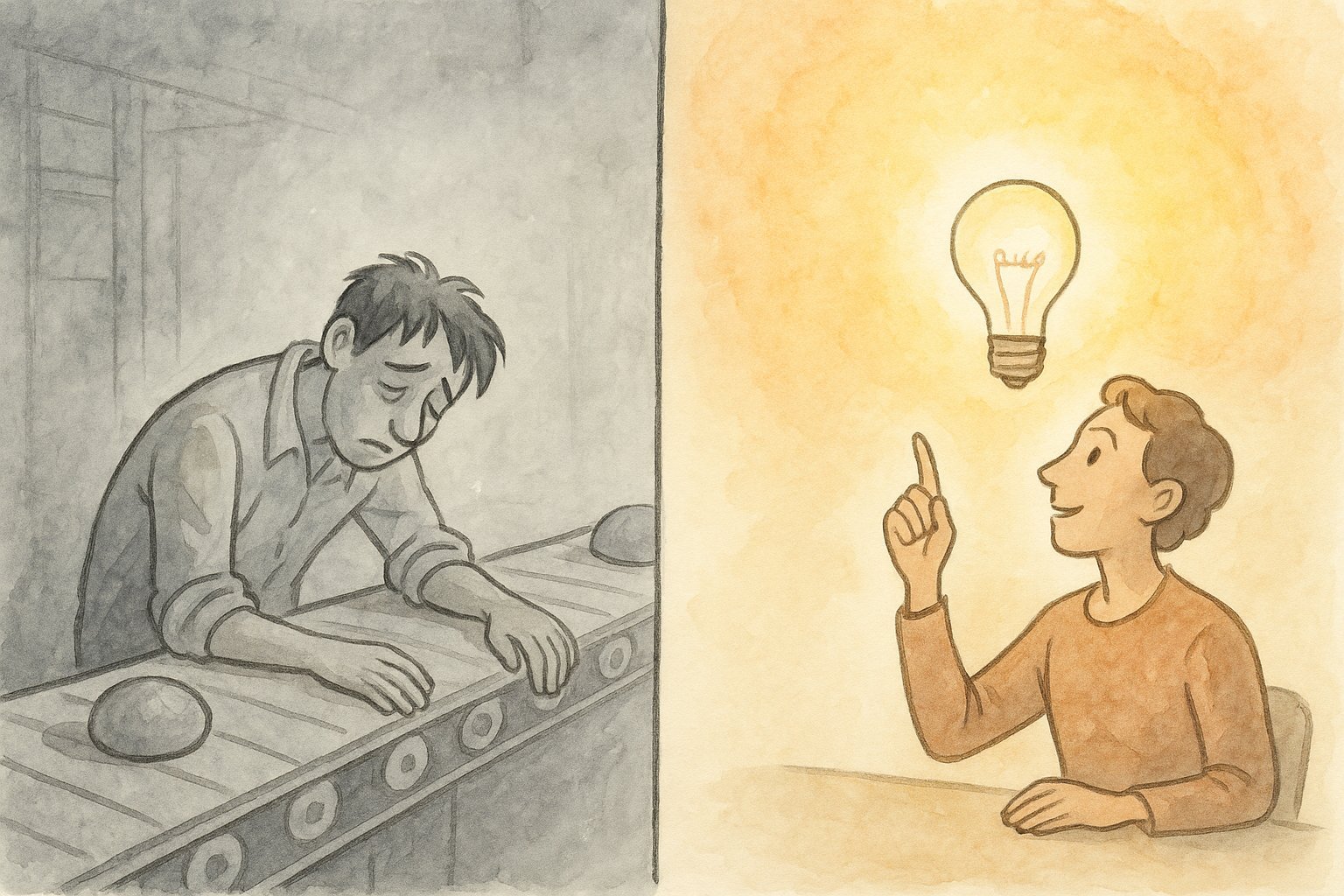
At the same time, there's something true about it. The complete absence of resistance isn't necessarily good for a person. Psychologists speak of "desirable difficulties" -- challenges that promote learning and growth. If AI takes over every unpleasant task, the question arises whether we're robbing ourselves of a training ground.
The synthesis lies, as so often, in the middle. Not every unpleasant task was ever character-building -- much of it was simply unnecessary suffering. But the ability to push through unpleasant things remains valuable. The difference is: In a world with agentic AI, you can choose which resistance you take on. Pushing through transforms from compulsion into choice. And a conscious decision to embrace effort is something fundamentally different from forced drudgery.
Work you don't want to do is -- to put it bluntly -- in the vast majority of cases simply poorly allocated work. Not morally bad, but badly allocated. If a system exists that can do this work, and a human does it anyway, that's not virtue. That's waste. Waste of the only good that is truly finite: a human life.
Economic Theory Has a Superintelligence Problem
Let's zoom out and take the macro perspective. What we're experiencing right now isn't simply another technology cycle. It's a break with the foundational assumptions of economics itself.
Every economic model since Adam Smith is based on an implicit assumption about human intelligence: It's limited, normally distributed, and the primary bottleneck of economic production. The range extends from "average" to "genius" -- from the cashier to Einstein. And within this range, all economic dynamics play out: labor markets, wage determination, innovation cycles, productivity growth.
Superintelligence -- or even just the practically unlimited availability of human-equivalent intelligence -- was not anticipated in any of these models. Not by Smith, not by Ricardo, not by Keynes, not by Friedman. Even the growth theorists of the 1990s, who modeled technological change as a driver, assumed that human capital would remain the limiting factor.
What economics never priced in:
- Intelligence as a commodity: When cognitive work can be produced at marginal costs near zero, the labor theory of value collapses.
- Unlimited scaling: One person can call upon the cognitive capacity of thousands -- without a hiring process, without salary, without an office.
- Non-linear productivity leaps: The difference between "with AI" and "without AI" isn't 20% -- it's 10,000%.
- Motivation as a new factor of production: When capital and labor are no longer bottlenecks, human enthusiasm becomes the limiting factor.
This has consequences reaching far beyond management consulting. If the classical factors of production -- land, labor, capital -- are supplemented or partially replaced by a fourth factor -- machine intelligence -- then we need new economic frameworks. The marginal productivity of human labor, the basis of every wage theory until now, loses its explanatory power when an agent does the same work at a fraction of the cost.
What we're observing instead is the emergence of an enthusiasm economy: an economic order in which the primary bottleneck is no longer capital, no longer labor, and no longer knowledge, but the ability to set a direction. To have a vision. To identify a problem worth solving. And to muster the energy to set the machines in motion.
This isn't utopian wishful thinking. This is what's happening right now. And those who don't see it will feel it -- in the form of employees who leave because they find more enthusiasm elsewhere. In the form of customers who defect because other providers deliver better results with more passion. In the form of market positions that erode because the competition isn't more diligent, but more enthusiastic.
What Does This Mean for Entrepreneurs?
Enough philosophy. What does all of this mean for you -- concretely, as an entrepreneur, as the managing director of an SME, as someone who gets up in the morning and runs a business?
Three things.
First: Your business model must answer the enthusiasm question. Not: "What can we make more efficient?" That's yesterday's question. But: "What are we passionate enough about to deploy the best people and the best machines on it?" If your honest answer is "We're just doing what we've always done, only faster with AI," then you have a problem. Because speed alone is no longer a differentiator when everyone can be fast.
Second: Talent management becomes enthusiasm management. The best people -- those who can orchestrate a thousand agents, who can translate visions into prompts, who truly leverage AI -- these people have free choice. They can work anywhere. They can start their own business. They can launch a company from a laptop and a cloud subscription that competes with yours. Why should they work for you? Only if you offer them something that excites them. Not money alone -- they can earn money on their own. But meaning, challenge, community, the opportunity to contribute to something important.
Third: The barriers to entry in your market are falling right now. Everything that was previously protected by knowledge advantages, team size, or capital intensity is becoming vulnerable. An enthusiastic solo fighter with the right tools can capture market share that used to be accessible only to corporations. Your defense doesn't lie in efficiency -- anyone can do that. It lies in enthusiasm, relationships, and experience. In what the machine cannot replicate.
Five concrete steps for the enthusiasm economy:
- Conduct an enthusiasm audit: Ask yourself and your team honestly -- which 20% of our work truly excites us? And can the remaining 80% be delegated to agents?
- Build agentic infrastructure: Identify three to five processes you could automate with AI agents starting tomorrow. Not as an experiment -- as standard practice.
- Reassess talent: Don't hire for skills, hire for the capacity for enthusiasm. Skills can be supplied by the machine. Passion cannot.
- Question knowledge advantages: Where does your business model depend on exclusive knowledge? That knowledge will be commoditized within 12-24 months. Build alternatives.
- Introduce enthusiasm as a KPI: Regularly measure how enthusiastic your team is about current projects. Low enthusiasm is an early warning signal -- not for employee satisfaction, but for productivity loss in the new economy.
Conclusion: The Question That Remains
We stand at a point where the old categories no longer hold. Time, attention, knowledge -- all resources we thought were scarce, and that are currently becoming scalable at breathtaking speed. What remains is the unscalable: the human ability to get excited about something. To choose a direction. To say: This here is important, this is what I'm deploying my thousand intelligences for.
The dialectic of this development is obvious. Thesis: AI frees us from all burden and opens up paradisiacal possibilities. Antithesis: This applies only to the privileged, and it destroys the character forged through resistance. Synthesis: We must democratize enthusiasm -- create access to the tools, but also foster the ability to set direction. Education that doesn't impart knowledge (the machine can do that), but judgment, curiosity, and the courage to ask your own question.
For entrepreneurs in the Mittelstand, this means: The competitive advantage of the next five years doesn't lie in better technology. Everyone has that. It lies in the better question. In the deeper why. In enthusiasm infectious enough to align the best minds and the most powerful machines toward the same goal.
The to-do list is empty. The agents are waiting. The only question that matters is: What are you enthusiastic about?
Answering the Enthusiasm Question for Your Business
At kiba Berlin, we help SMEs strategically navigate the shift to agentic AI -- from process analysis to implementing AI agents that free your team to focus on what truly matters. If you want to know where your company stands in the enthusiasm economy, talk to us.
32 AI Workflows for SMEs
Free practical guide with cost estimates, decision matrix, and funding guide for SMEs.
Download PDF for freeReady for the next step?
Talk to our AI experts – the first consultation is free and without obligation.
This article is part of our comprehensive guide: AI for SMEs — The Complete Guide for Medium-Sized Businesses
Related Articles
It’s Not Over: What the Jevons Paradox Reveals About AI and Work
Jevons paradox, AI, and work: why cheaper intelligence doesn’t automatically mean less employment—and what SMEs can learn from it.

The Philosophy Factory: Why the Future of Work Does Not Lie with Machines
A CEO wants to replace 90% of his workforce with AI. Why this is the path to oblivion and how Human-in-the-Loop leads to 10x-Teams instead.

The Last Job: AI, Work, and the Future of Human Value Creation
Will it exist – the proverbial last job a human ever performs before machines take over? This article examines the dialectic between AI euphoria and fears about the future, drafting a vision of human-machine symbiosis.