The Philosophy Factory: Why the Future of Work Does Not Lie with Machines
A CEO wants to replace 90% of his workforce with AI. Why this is the path to oblivion and how Human-in-the-Loop leads to 10x-Teams instead.

Recently at breakfast with other CEOs: A CEO leans forward and says quietly but proudly: "In five years, I'll only need 10% of my people – AI will do the rest." This sentence makes me shudder. I look into his euphoric face and think: In five years, his company might not exist at all. Why? Because he's in the process of ripping out the heart of his enterprise.
While he rhapsodizes about his vision of a largely human-free company, I think of an old joke: A son announces to his father that he wants to study philosophy. The father replies dryly: "Great – a philosophy factory just opened on the corner." What served for decades as a mocking jab at impractical humanities now turns into its opposite. Because that's exactly what we need: a philosophy factory – only there, AI systems produce texts, analyses, and answers, while humans understand language and meaning.
The 90% Illusion: When Efficiency Becomes an Existential Threat
We read it everywhere: "AI replaces humans, mass layoffs." OpenAI CEO Sam Altman claims the next billion-dollar company could consist of a single person – thanks to AI. Anthropic's Dario Amodei predicts AI could eliminate half of all entry-level jobs in five years. This year alone, tens of thousands of tech employees lost their jobs because corporations bet on AI "efficiency."
The three fatal fallacies of the 90% strategy:
- Innovation dies: Humans innovate – AI only imitates. No creative minds, no new ideas.
- Chaos emerges: Automation without understanding leads to wandering bots and error messages.
- Trust crumbles: Customers, partners, and talent avoid companies without human soul.
Fortune Magazine rightly warns: "Not only is this short-sighted, it's fundamentally bad business." Companies that are now firing people in the name of AI will be the losers in five years. Why? No workforce, no ideas. No ideas, no new products. Who will feed AI with fresh thinking in the future when 90% of the workforce is gone?

10× More Productive: The Dream Team of Human and Machine
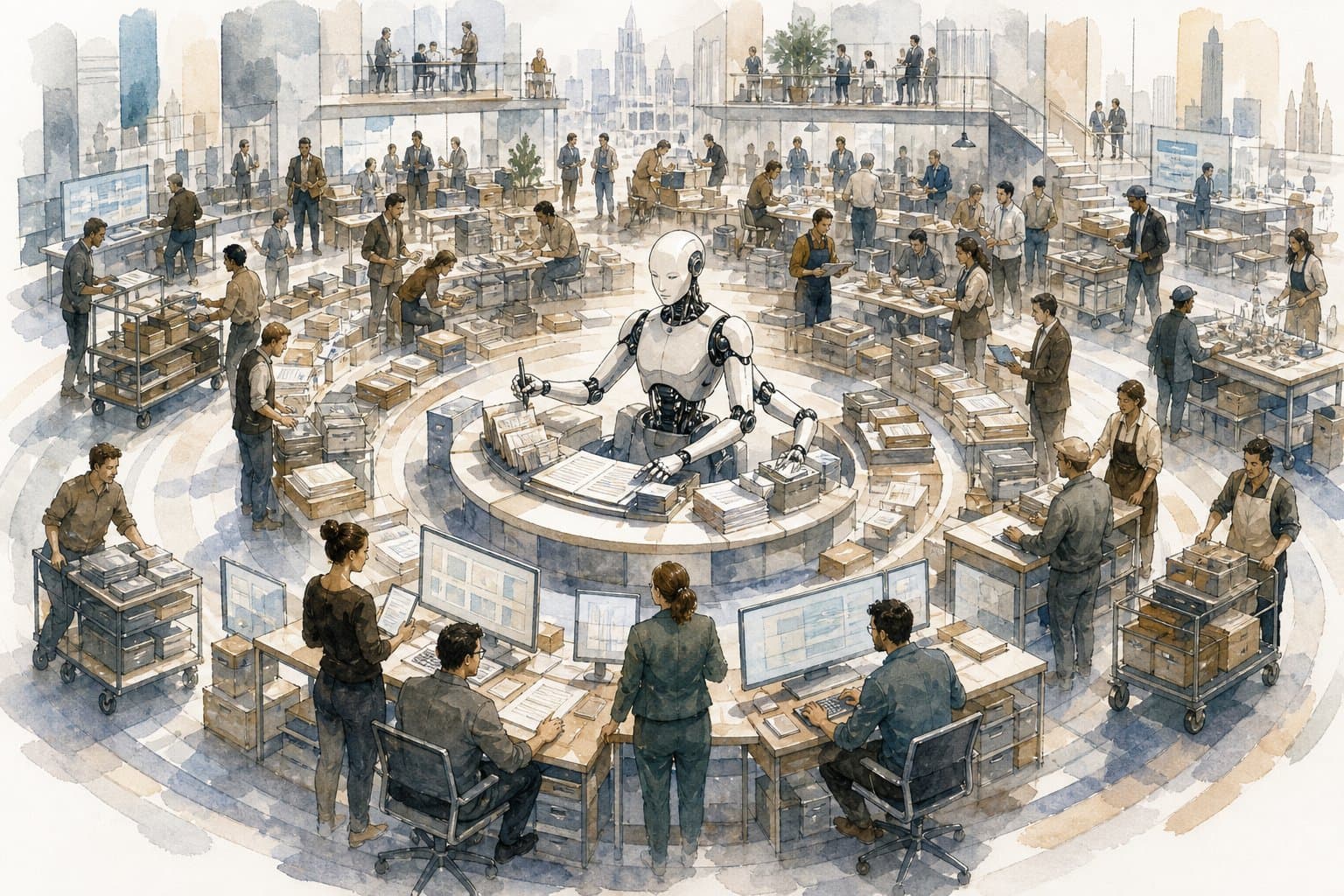
Instead of this scorched earth approach, we need a different vision: What if AI doesn't replace 90% of humans, but makes every human 10× more productive? The future belongs to hybrid teams – where artificial intelligence and human intuition mutually elevate each other.
We've seen exactly this in the chess world: Human-machine teams temporarily beat both the best grandmasters and the best computers – collaboration beats confrontation. With AI and humans, results emerge that neither AI nor humans alone would have achieved. 1 + 1 = 3, when the chemistry is right.
Practical Example: The 10× Effect in Action
Imagine: AI answers 100 customer inquiries per day, your sales team filters out the 5 truly promising ones based on experience. Suddenly your company handles 1000 inquiries in the time it used to handle 100. Your team is free for what matters: nurturing relationships, closing deals, solving problems creatively.
The New Division of Labor: Routine to Machines, Creativity to Humans
Developers write error-free code in record time thanks to AI assistants. Consultants have translations and research ready in seconds to focus fully on the client. Editors use AI tools for fact-checking and routine paragraphs while they set the story and tone themselves. The result: workforces that buzz with energy instead of being worn down.
The Hour of Philosophers: Why Language is the New Gold
Interestingly, the sought-after skills are shifting fundamentally. In the past, brilliant programmers with deep mathematical knowledge were considered the indispensable heroes of the tech industry. But with the spread of AI, especially generative language models, another ability gains enormous importance: the art of language.
Suddenly, those who can express complex relationships understandably in words, formulate precise instructions, and handle language creatively have the advantage – in short, philosophers, linguists, teachers, or writers rather than purely technical specialists.

"Prompt engineering is fundamentally a linguistic discipline, not a technical one. The ability to put logical structures into words and juggle abstract concepts becomes more valuable in dealing with AI than hardcore coding."
Major research institutes like the Alan Turing Institute specifically hire philosophers to address the ethical and social questions of AI. But it's not just about ethics – it's about prompt engineering, the key competency of the coming years. The best results emerge when formal-logical thinking and linguistic-conceptual thinking come together.
Human-in-the-Loop: Humans Maintain Control
This revolution demands more than new tools – it demands a new mindset. Human-in-the-Loop is the magic word. Behind it lies common sense: Humans remain part of every important loop. AI handles routine, but humans maintain control.
Why "Errors" Suddenly Become a Feature
Where humans remain in the loop, creativity, chance, empathy also remain. AI alone is strictly logical and incorruptible – sounds great, but rarely produces breakthrough ideas. Many innovations in history were happy accidents or "mistakes" – from the discovery of penicillin to Post-it notes. AI would hardly produce such things; it's too focused on optimization.
Human-in-the-Loop means concretely:
- Ethics and responsibility retain a seat at the table
- Humans make final decisions about AI-generated results
- New roles emerge: AI Trainer, Prompt Engineer, AI Ethics Manager
- Continuous education instead of fear of job loss
Humanity as Competitive Advantage
Work is more than just result production. Work is social glue, meaning-maker, identity. Would you entrust your life to a perfectly programmed robot surgeon who has no ounce of compassion? Or would you prefer the somewhat fallible but empathetic human doctor who sees and calms your fear?
Culture Decides: How to Magnetically Attract Talent
A friend of mine, a physiotherapist, recently demonstrated on a small scale what a human-friendly work environment can achieve. He founded his own practice – a venture on credit that almost overwhelmed him. But he put everything into creating an atmosphere where employees feel comfortable and love their patients.
With success: Barely opened, two excellently trained therapists wanted to work for him specifically because the climate and vision there convinced them. Those who create an environment where people work gladly and meaningfully attract talent magnetically.

A large share of organizations worldwide report having great difficulty filling open positions with qualified candidates. Especially the skills that companies need for AI implementation are in hot demand and scarce in the job market. Under these conditions, it's fatal to alienate your own specialists prematurely.
The Skills Shortage Paradox
According to an industry survey, many companies increasingly focus on upskilling and training their employees rather than recruiting new people externally. The motto: develop super-users for new AI tools from within their own ranks. Those who train their workforce early in handling AI gain a competitive advantage.
Conclusion: Human-in-the-Loop – or Left Behind
The wake-up call is overdue. Companies that see people only as cost factors and expect AI to be a miracle solution will soon be history. They're making themselves obsolete. The real winners of the next five years will think differently: They bet on integration instead of elimination, on cooperation instead of confrontation.
Five years pass faster than you think. So let's ask ourselves: In what world do we want to wake up in 2030? In a world where offices stand empty and formerly proud companies serve only as cautionary examples? Or in a world where hybrid teams buzz with ideas because humans and AI work hand in hand?

At a Glance: How Companies Future-Proof Themselves
- Retain and train employees: Invest in upskilling instead of layoffs
- Use AI for support: Tool for superheroes, not replacement for humans
- Culture as magnet: Create work environments where talent can grow
- Interdisciplinary teams: Connect technical experts with lateral thinkers
- Maintain human responsibility: Humans remain the final decision-making authority
Human-in-the-Loop is not just a buzzword – it's the key to reinventing work and leading our companies into a golden age of productivity. Those who courageously unite humans and machines today own the future. All others can start writing their farewell letters.
Shaping the Future of Work Together
We at kiba Berlin support you in implementing Human-in-the-Loop strategies in your company. From AI integration to culture development – contact us for a non-binding consultation about your hybrid future.
32 AI Workflows for SMEs
Free practical guide with cost estimates, decision matrix, and funding guide for SMEs.
Download PDF for freeReady for the next step?
Talk to our AI experts – the first consultation is free and without obligation.
This article is part of our comprehensive guide: AI for SMEs — The Complete Guide for Medium-Sized Businesses
Related Articles
It’s Not Over: What the Jevons Paradox Reveals About AI and Work
Jevons paradox, AI, and work: why cheaper intelligence doesn’t automatically mean less employment—and what SMEs can learn from it.

The Golden Age of Industry Software — Why Building from Scratch Beats Customization
Why SMEs should build industry software from the ground up now: AI cuts development costs drastically. MCP makes systems agent-ready.

The New Currencies: Why Enthusiasm Is the Last Scarce Resource
From time to attention to enthusiasm: Why AI agents are shifting the scarce resource -- an economic analysis.