The Golden Wave: Turning Rented Intelligence into Assets You Own
Frontier intelligence is unusually affordable today. Lasting value comes from turning it into proprietary knowledge, software, and skills.

At a Glance
- The jump between model generations is often not a modest quality gain. It can move a task from impossible to trivial.
- Lasting value does not live in a subscription. It lives in the infrastructure you build with the intelligence available today.
- No one knows whether frontier models will become more expensive, cheaper, or distributed in an entirely different way. That is precisely why model agnosticism matters.
- Agents without a narrow scope, separate permissions, and controlled network access are not a setup. They are an open risk.
A Status Report That Should Surprise No One
It is time to take stock. Not because everything has developed in some unexpected way, but because the opposite is true: the trends we have been writing about for months continue to move in roughly the direction they were already pointing. New providers have entered the field. But the two centers where the frontier is still being decided remain Anthropic and OpenAI.
Anthropic has had a strong run with its Opus line since the beginning of the year, most recently with Claude Opus 5 on July 24, explicitly positioned for complex agentic and enterprise work. OpenAI, meanwhile, has mounted a strong response with Codex: first among developers and now explicitly for roles beyond software development. Yet the most tangible improvement of recent months for the everyday work of many managing directors may be something else: Claude Cowork, task-oriented knowledge work outside the chat window. In my observation, this is a bigger step for ordinary operations than most benchmark announcements.
Then there is the agentic layer, which continues to grow without producing a single defining revolution over the past few months. Nous Research describes its Hermes Agent as a model-agnostic agent with Telegram integration, a learning loop, and a migration path from OpenClaw. That is the vendor's description, not an independent assessment of quality. The tone of the communication suggests that the race to build the grown-up version of OpenClaw has already been won. Whether that is true will be decided in operating environments, not in repositories.
And then there was the drama around Fable 5 and Mythos 5: announced on June 9, access suspended after the export controls of June 12, and partially restored on July 1. You can read this as a communications event. Above all, it shows how quickly access to frontier models can depend on decisions made outside your company, and not even by the provider alone.
A Better Model Does Not Solve Your Problem Better. It Makes It Solvable.
This is the point that almost always disappears in comparison tables. When a new frontier model arrives, people talk about it as though it merely completes the same tasks a little more reliably. That is not the decisive measure. The decisive question is whether a task falls within the realm of the possible at all.
I have experienced this myself at least a dozen times. A problem was not merely cumbersome or error-prone with the previous generation. It was simply unsolvable. Then the next version arrived, and the same task became child's play. Not child's play in the sense of faster, but in the sense that you sit down, describe the task, and it gets done.
That is why the difference between an inexpensive subscription and access to the best available intelligence is not linear. A two-hundred-euro plan is not simply ten times as good as a twenty-euro plan. For a particular class of task, it can be the difference between zero and one. This is my assessment from practice, not a formal metric. It nevertheless has immediate consequences for a business: anyone working only with the second tier will never see part of their own opportunity space. You cannot plan for something you have never experienced as possible.
Why I Call It a Golden Wave
Relative to its potential value, frontier intelligence is unusually affordable right now. The reasons are open to debate: capital inflows, market-share strategies, deliberate pricing. For your decision, the cause matters less than the observation itself. What can now be accessed for a three-figure monthly sum did not exist as a purchasable service three years ago. Even a large department could not simply order it. It did not exist.
What happens next is uncertain, and I want to leave that uncertainty intact. One path is that the current phase ends and access to the frontier becomes much more expensive: perhaps four figures, perhaps more, with pricing tiers that become the entry ticket for smaller businesses. Another path is that efficiency gains keep driving costs down and frontier intelligence becomes cheaper than it is today. A third is that distribution becomes a political question, shaped by export controls, licensing, and regional access. The events surrounding Fable 5 showed that this third path is not theoretical.
I do not know which of these curves we will get. No one does. But all three lead to the same practical conclusion: turn the intelligence you can access cheaply today into something that belongs to you. The subscription is not an asset. It is rent. The asset is what you build with it: your knowledge in machine-readable form, your processes expressed as software, your data foundation, and the capabilities of your people.
In this gold rush, the shovels are being handed out at prices that bear little relation to their potential yield. Use one for a few exploratory holes and you have seen an interesting tool. Use it to build infrastructure and you retain something when the price of the shovel changes.
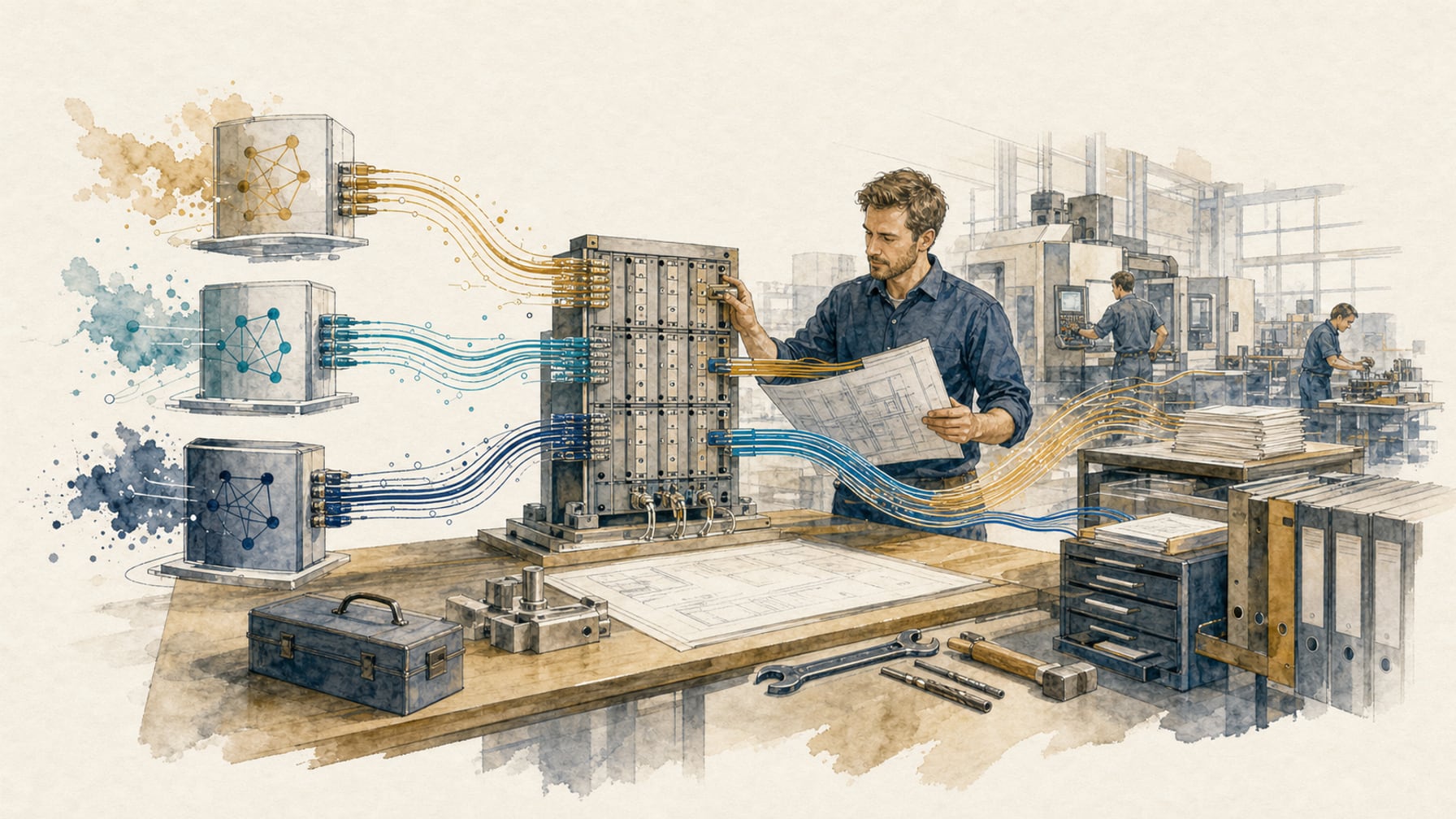
Model Agnosticism: The Patch Panel Belongs to You
In concrete terms, this means you need a process layer of your own. For some companies, that genuinely becomes proprietary operating software that reflects the way the business works more accurately than any standard product. This does not mean every company should rewrite its ERP. But your process logic, your data, and the interface your people use every day must not disappear completely into one provider's prompts and product policy.
Behind that proprietary layer sits a patch panel. Today, an Anthropic or OpenAI model may be doing the work. Tomorrow, it may be Kimi, DeepSeek, a European model, or something that does not yet have a name. Whatever computes behind that panel remains a supplier. Suppliers can be changed. If instead your process logic lives inside the prompt of someone else's product, your data sits in its storage, and your interface depends on one vendor's roadmap instincts, you have not bought a tool. You have rented a dependency.
The benefit of this architecture becomes visible the moment the next generation arrives. If you have a patch panel, you switch the model and bring the new capability into existing work within days. If you do not, you return to evaluation from scratch. And the stronger the models become, the larger the gap created by those weeks.
There is no perfect abstraction layer. Models behave differently, prompts are not entirely portable, and switching will always require some rework. But the difference between two weeks of adaptation and six months of rebuilding is exactly the difference you can protect against in this phase.
Agents Without Scope Are Not a Setup. They Are an Open Door.
My recommendation has not changed, and it is becoming more urgent: do not deploy these agent systems out of the box, connect them to everything you have, and let them run. Narrow scopes are not bureaucracy. They are the condition under which these systems can enter a business at all.
In practice, that means separate permissions instead of universal access, clearly defined data spaces instead of access to everything, controlled network access instead of the open internet, and logs that let you reconstruct what happened. Highly personal data plus a free shell plus an open network is not a setup. An agent that can communicate outward at will while seeing everything is one prompt injection away from a data leak.
There is no need to discuss this in purely speculative terms. Anthropic itself documents that agents were able to exfiltrate data through approved domains despite sandboxing and an egress allowlist. This is not an argument against agents. It is an argument for keeping their scope small enough that misbehavior remains contained, and for enforcing those boundaries technically rather than through office policy.
The fact that there have been few public incidents so far tells us less about the risk than about how few systems have been running in production for long enough. I would not bet on that record holding.
Hold On to the People, and Not Just One of Them
The second directive is the one that meets the most resistance. Many management teams are quietly running the same calculation: if I can multiply my own output with these tools, I need fewer people. In the short term, that calculation can even be correct, at least on the cost line.
Strategically, however, it is weak. If you amplify only yourself, you remain one perspective with greater throughput. Your competitor, who gives the same tools to the entire team, carries higher running costs but gains something else: twenty people with different expertise, different customer relationships, and different questions, all working with greater leverage. Even if each individual starts from a lower level than you, the range of paths explored is much larger. Progress in systems like these does not arrive evenly. It comes in leaps, often in places no one expected.
Einstein's equation was not created by majority vote. At the same time, it did not appear from nowhere. Without the prior work of Lorentz, Poincare, and many others, the conceptual leap would not have been possible. That is the entrepreneurial point. A large volume of uniform processing cannot replace a new perspective. But an environment of different, well-prepared perspectives increases the chance that someone will see the leap at all.
You need people who can tell the difference between a plausible answer and a correct one. And you need enough different people for someone to ask the question no one has thought of yet. That is why enabling the team in this phase is not a social program. It is the investment with the greatest optionality. You can swap models. You cannot order a replacement team that has learned how to think with this class of tools.

What This Means in Practice
The image of the wave suggests several practical directives that I believe will remain sound over the coming months:
- Do not economize on access to the frontier in the wrong place. For the tasks that carry your business, test the best available model, not only the cheapest. Otherwise, you will not discover what is possible today.
- Make knowledge exportable. What is currently buried in people's heads, email threads, and accumulated spreadsheets must be brought into a form machines can read. That is the real work, and it does not become obsolete with the next model.
- Build a process layer of your own with a patch panel behind it. Process logic, data, and the working interface remain inside the company; the models behind them stay interchangeable.
- Deploy agents with a narrow scope, separate permissions, and controlled network access. Start small, keep logs, and expand only after that.
- Bring the team with you. Not an hour-long tool showcase once a week, but real work on real tasks, allowing every role to find its own use cases.
I believe the window for the first three points is short. Not because a fixed deadline exists, but because too many third parties have a say: provider strategy, capital markets, export controls, security requirements. The more you convert into assets of your own before those conditions change, the less exposed you are to a shift you cannot influence. If access to the frontier eventually becomes very expensive, a company with infrastructure can evaluate that bill against a clear return. For a company without infrastructure, it becomes an entry barrier.
At kiba, this is precisely where we work: turning a company's knowledge into a usable form, expressing its processes as proprietary software, and keeping the models behind it interchangeable. If you are wondering how quickly political decisions can change access to open models, you will find a deeper exploration in Mythos, Power, and the End of Open Intelligence. And if you are deciding whether to customize your current industry solution or build the relevant parts anew, the case is laid out in The Golden Age of Industry Software.
The golden wave is not a particular model. It is this brief historical condition in which a great deal of intelligence is available before most companies have built a place where it can create lasting effects. Catch the wave now, and you can turn rented intelligence into value of your own.
32 AI Workflows for SMEs
Free practical guide with cost estimates, decision matrix, and funding guide for SMEs.
Download PDF for freeReady for the next step?
Talk to our AI experts – the first consultation is free and without obligation.
This article is part of our comprehensive guide: AI for SMEs — The Complete Guide for Medium-Sized Businesses
Related Articles

The Golden Age of Industry Software — Why Building from Scratch Beats Customization
Why SMEs should build industry software from the ground up now: AI cuts development costs drastically. MCP makes systems agent-ready.

Top 6 AI Tools for Process Optimization 2025: Agentic Systems for Sustainable Digital Transformation
The 6 best AI tools for process optimization in 2025: How agentic systems and clear SOPs deliver real efficiency gains for mid-sized businesses.
It’s Not Over: What the Jevons Paradox Reveals About AI and Work
Jevons paradox, AI, and work: why cheaper intelligence doesn’t automatically mean less employment—and what SMEs can learn from it.